IRIS
Rain-aware irrigation guidance, leaf screening and a plot assistant on one rice plot.
Problem
Indonesia harvested 10.05 million hectares of paddy in 2024, which makes rice water management a national sustainability question rather than a farm-level one. Safe alternate wetting and drying can cut irrigation and methane while holding yield, but it needs two things a farmer standing in a field rarely has together: the current water level against the stage rules, and the next three days of rain. Farmers read field tubes and inspect leaves as separate tasks; nobody hands them one answer for one plot.
Constraints
- No field validation was possible within the project window, so no accuracy or water-saving claim can be made about Indonesian fields.
- The system must never actuate anything. It does not control a pump, diagnose disease or prescribe pesticide doses.
- The leaf model is trained and evaluated on a public dataset, and the water and methane figures come from a simulation — those categories cannot be blurred into each other.
- An unattended farm-control service is explicitly out of scope; the repository says so where a reader will look.
Decisions
-
Keep the farmer or extension officer as the decision-maker: the system recommends, records the confirmation, and never closes the loop.
rejected Closed-loop irrigation control that opens and closes the gate from the sensor reading.
A wrong recommendation costs a season, and an actuator turns a wrong recommendation into a wrong action without anyone in between. The confirmation record is also the honest unit of evidence: it shows what the system said, what a human decided, and what happened next — which is the thing a field study in the next phase would actually need.
-
Label every result by its evidence class, in the interface and in the README, and keep those labels distinct.
rejected Report the leaf model's 0.9784 held-out accuracy as the system's accuracy.
That number comes from a public dataset, not from Indonesian field leaves, and the water and methane results come from a simulation rather than measurement. The repository uses the labels working prototype, simulated, modelled, public-dataset benchmark and field validation pending on purpose — a reviewer needs to know which claim they are looking at, and the demo plot card says the data is synthetic rather than implying a real field.
-
Let the official BMKG forecast gate the irrigation advice with an explicit rain-hold rule, instead of relying on sensor history.
rejected Infer the rain from the water-level drop rate.
Sensor history tells you what already happened; the expensive mistake is irrigating the night before rain. A 72-hour official forecast with a 15mm hold threshold is the one input that turns the recommendation from reactive into preventive, and using the government's own feed means the data source is defensible rather than scraped.
-
Ship a deterministic 30-day demo seeded from committed inputs so the walkthrough can be reproduced exactly.
rejected A live demo against whatever the database happens to contain.
A judge, an examiner or a teammate should be able to run one command and see the same day of the same plot that the screenshots show. Reproducibility is what separates a demo from a story, and it is the same reason the 100-day evidence run is generated from committed inputs rather than hand-typed.
The hard part
Keeping four kinds of truth apart inside one interface. A water level from a sensor is measured, the methane number is simulated, the leaf class is a public-dataset benchmark, and the rain flag is an exploratory model. Every one of them arrives on the same screen as a confident-looking number, and the genuinely hard work was designing the labels, the state vocabulary and the review step so that a farmer — or a reviewer reading the repository — can tell which is which without reading a methods section. The classifier itself was a training run; the discipline was in what I refused to let the interface imply.
Outcome
-
0.9784
held-out accuracy, five-class leaf screening (public dataset, n = 1,621)
-
2,880
readings in the deterministic 30-day demo
-
100 days
1ha zero-rain simulation, reproducible from committed inputs
-
Pending
Indonesian field validation — not established
Figures and revisions
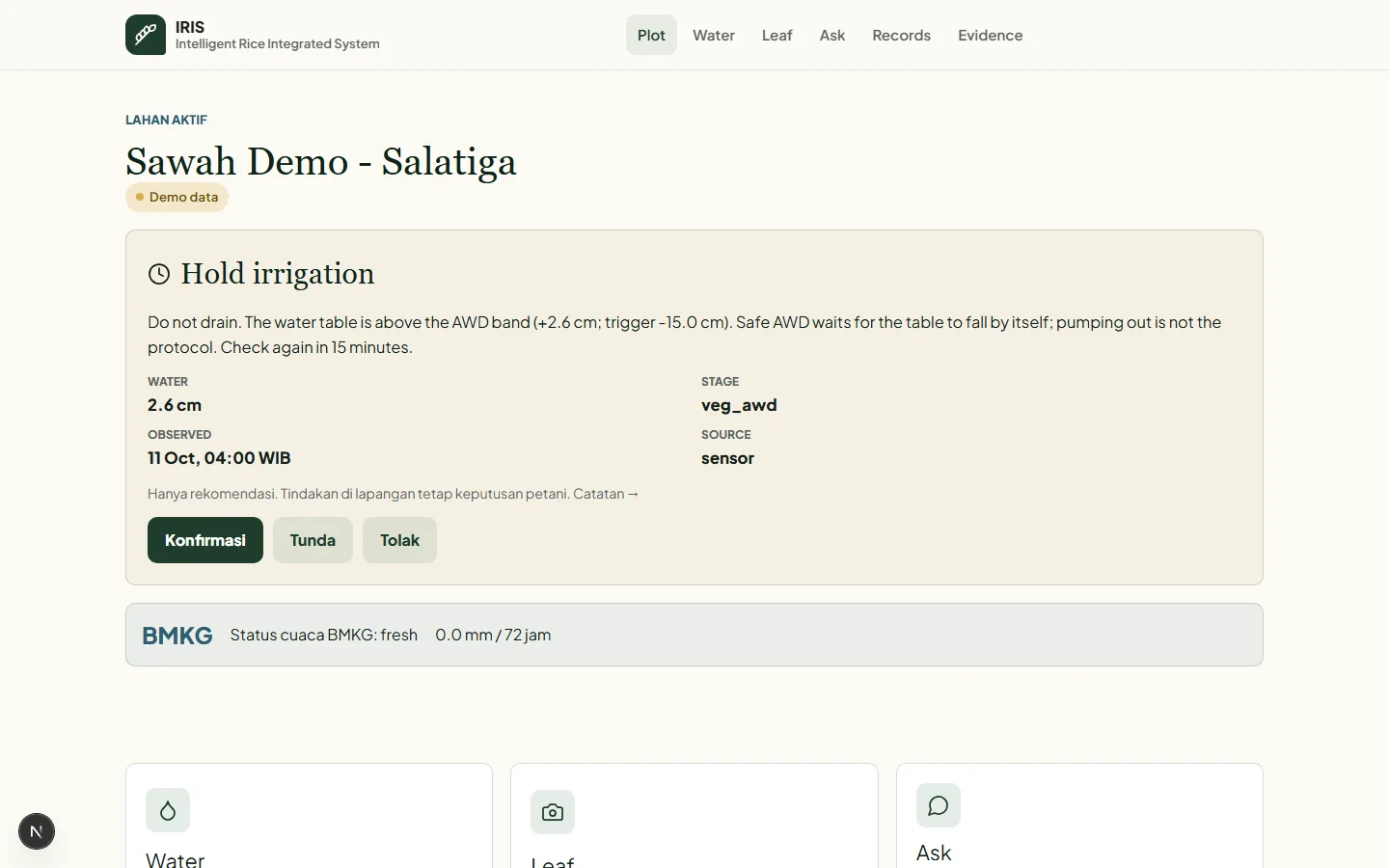
source: IRIS local prototype · seeded 30-day demochecked: 11 Oct 2026
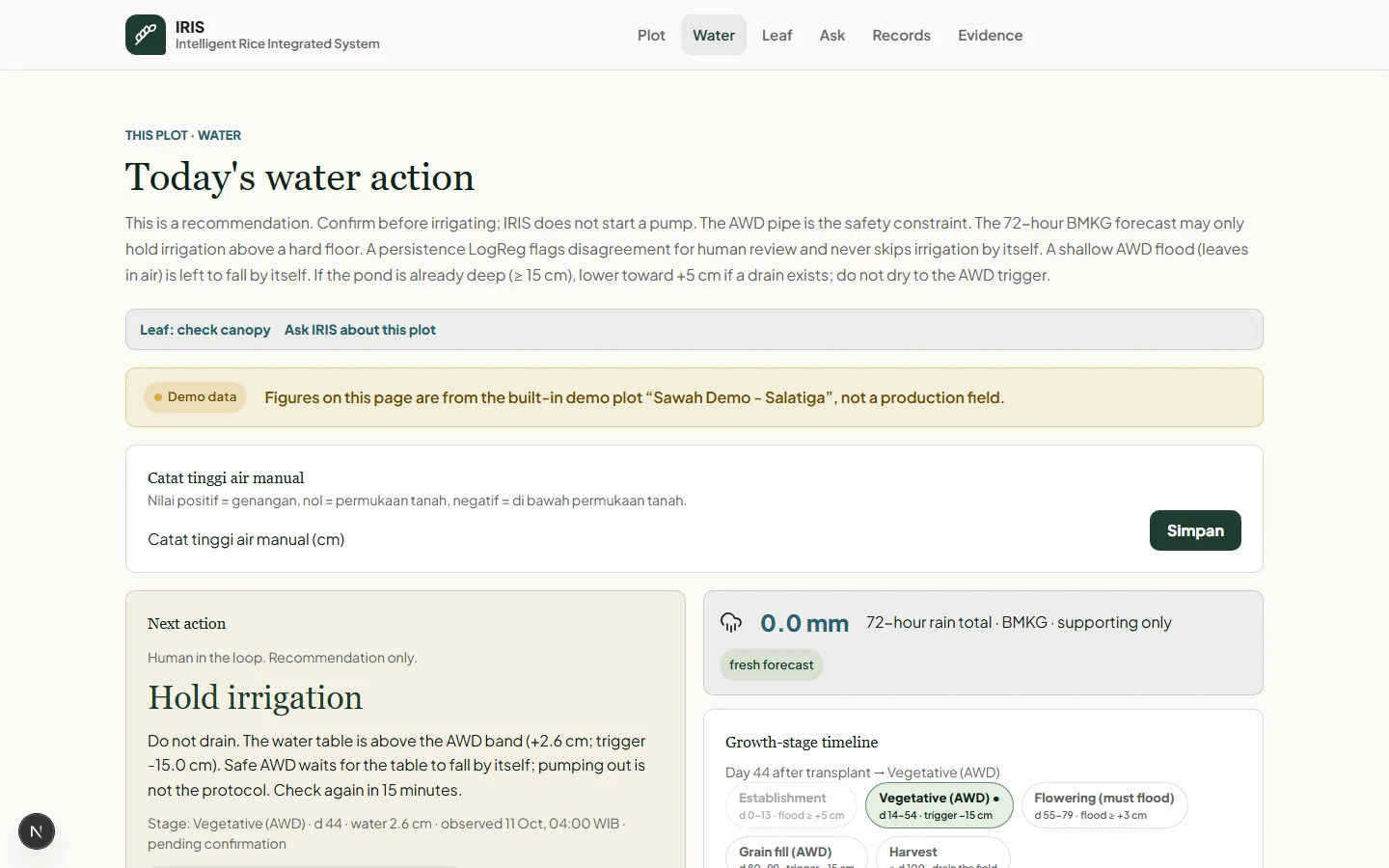
source: IRIS local prototype · seeded 30-day demochecked: 11 Oct 2026
| plate | source | checked |
|---|---|---|
| FIG. 1 | IRIS local prototype · seeded 30-day demo | 11 Oct 2026 |
| FIG. 2 | IRIS local prototype · seeded 30-day demo | 11 Oct 2026 |